Bingo 101 Jhandi Munda brings one of the oldest dice games in India into the app. It is also known as Langur Burja, and many players first saw it on a cloth mat at a village fair or during a festival. Six dice are rolled at once, each die carries six symbols instead of numbers, and you bet on the symbol you think will show. The more dice that land on your symbol, the more the bet pays.
This guide covers how a round runs, what the six symbols are, how the payout grows with each match, what the house edge means for you, and what to check on the screen before your first bet. If you would rather see the whole lobby by category, the Bingo 101 all games list has the full breakdown.
Real money is involved here. Everything below is written for players aged 18 and over.
- Bingo 101 Jhandi Munda is the traditional Indian six dice game, also known as Langur Burja, on the card, table and board shelf.
- Each die shows six symbols, and you back one or more of them before all six dice roll together.
- You are paid by how many dice land on your symbol, and about one round in three shows none of it.
- Payouts vary between tables, so read the table screen or rules button before your first bet.
- Results settle on the server, so no predictor app, pattern or lucky symbol can change a roll.
Where Jhandi Munda Sits in the Bingo 101 Lobby
The lobby groups games by type, and Jhandi Munda belongs to the shelf for card, table and board games. It sits there with Teen Patti, Rummy, Andar Bahar, Dragon vs Tiger and Seven Up Down. The lobby grows over time, so the in-app list is always the definitive one.
| Category | What sits there | How you play it |
|---|---|---|
| Card, table and board games | Teen Patti, Rummy, Andar Bahar, Dragon vs Tiger, Seven Up Down, Jhandi Munda and more | Pick a side, a total or a symbol, then watch the round settle |
A slot asks nothing of you after the button press, and a crash game asks you to pick a moment to cash out. Bingo 101 Jhandi Munda asks you to choose one or more symbols before the roll, and then six dice decide the rest. Rounds are short and there is no second decision once the dice are thrown.
For players who grew up with the game, it is probably the most familiar title on the shelf. That familiarity is worth something, but it also brings old habits with it, like favourite symbols and lucky streaks, and the app does not reward either.
The Six Symbols on Each Die
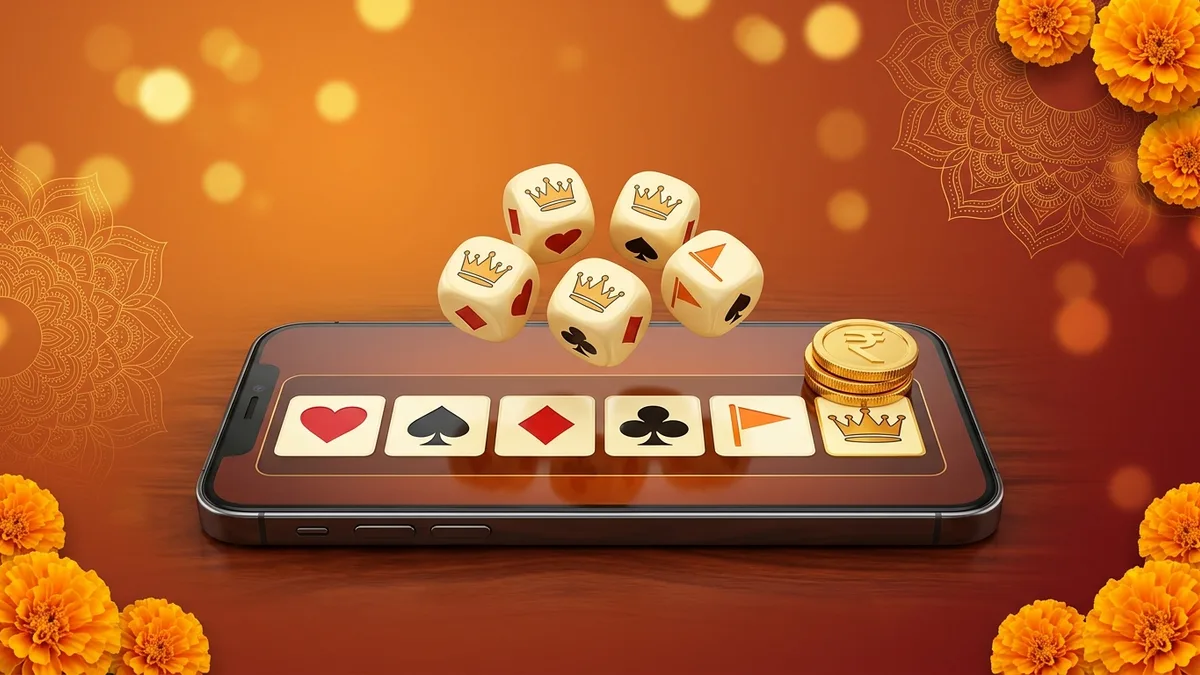
Every die in Bingo 101 Jhandi Munda is a normal six sided cube, but the faces show pictures instead of dots. The same six symbols appear on all six dice.
- Flag. The jhandi that gives the game the first half of its name.
- Face. The munda, which gives it the second half. Some versions show a crown here instead.
- Heart.
- Spade.
- Club.
- Diamond.
Four of the six are the familiar card suits. The flag and the face are what make it Jhandi Munda. On the table each symbol has its own betting square, and the dice result is shown as six symbols side by side.
How a Round of Bingo 101 Jhandi Munda Is Played
Every round follows the same order. Once you have watched one, you know the game.
- The betting window opens. Most tables show a timer while bets are accepted.
- You choose a symbol and place a stake on its square using the chip selector. Most tables let you back more than one symbol in the same round, each as a separate bet.
- The window closes and all six dice are rolled together.
- The table counts how many of the six dice show each symbol.
- If your symbol appears on at least the number of dice the table pays for, you win, and the payout rises with every extra match. If it does not appear, the stake is lost. Then the next round opens.
That last step is where Bingo 101 Jhandi Munda differs from most dice games. You are not betting on a total or a side. You are betting on a count: how many of six dice will agree with your choice.
How Matches Are Usually Paid
Because the payout depends on a count, it helps to know how often each count actually happens. Each die has a one in six chance of showing your symbol, and there are six dice. The table below shows roughly how often a single chosen symbol lands on each number of dice. This is general dice math, the same on any fair set of six dice.
| Dice showing your symbol | How often, roughly |
|---|---|
| None | About 33 rounds in 100 |
| One | About 40 rounds in 100 |
| Two | About 20 rounds in 100 |
| Three | About 5 rounds in 100 |
| Four | Less than 1 round in 100 |
| Five or six | Very rare, a handful in 10,000 or fewer |
So a single match is the most common outcome, and about one round in three your symbol does not show at all. Three or more matches are rare enough that most sessions will see only a few.
What the Table Usually Pays
On most Bingo 101 Jhandi Munda tables, one match returns a small amount, often around the stake, and each additional match multiplies it. Some versions start paying only from two matches. These are common shapes of the game, not a promise about any table. The exact payout for each number of matches is shown on the table screen or behind the rules button, and that number is the only one that counts.
How a Round Is Decided and Where the Edge Comes From
At a Bingo 101 Jhandi Munda table, the result is decided by the roll and nothing else. The outcome is settled on the server, and the dice animation you see is showing a result that has already been fixed. You cannot influence it, and neither can any other player.
The house edge in Bingo 101 Jhandi Munda is easy to miss, because the payouts climb so steeply for big counts. It lives in the gap between how often each count happens and what the table pays for it. Every payout is set slightly below what its true chance would justify, so across a large number of rounds the table keeps a share of every stake. The big payouts for four or five matches look generous, but they come up so rarely that they do not change the overall direction.
No figure is given here, because the number that applies is the one in the rules of your table. What never changes is that direction. Over enough rounds, more money goes to the table than comes back. A run of double and triple matches is a short stretch of variance, and it ends.
Backing more than one symbol in Bingo 101 Jhandi Munda does not change this. Each symbol is a separate bet with its own edge, so spreading chips across three squares means three stakes that each lose slowly over time. It can make a round feel safer, because one symbol often shows, but the bets that miss pay for the one that hits, and usually a little more.
Reading the Bingo 101 Jhandi Munda Table Before Your First Bet
Spend a minute with the screen before you place anything. Layouts differ, but most tables show the same elements.
- The six symbol squares. One for each symbol, where your chips go. Check that you know which picture is which before the timer starts.
- The payout table. If the table shows it, read the payout for one, two, three and more matches. This is the most important number on the screen.
- The chip or stake selector. Often a row of chip values. Pick your stake early, not in the last seconds of the window.
- The betting timer. If the table has one, bets close when it runs out. A bet placed in a rush is often a bet you did not mean to make.
- The history strip. If the table has one, it shows recent rolls. It is a record of what already happened and it does not predict the next roll.
- The rules or information button. It is the right place to check the payouts and side rules this guide leaves open.
None of this makes a bet better. It makes it informed.
Finding Jhandi Munda in the App
Bingo 101 Jhandi Munda is inside the main app, on the shelf for card, table and board games. Open the lobby, switch to that category and look for Jhandi Munda by name, or type it into the search box.
There is no separate download for it. The game is a section of the single app, so a standalone Jhandi Munda app is not something to look for. The Bingo 101 app is Android only, currently version 1.2.0 at 35.7 MB, and runs on Android 5.0 and above. To install it, follow the Bingo 101 APK download guide, which covers the checks to run before you open the file.
Every game draws on the same wallet, so the balance you use for Bingo 101 Jhandi Munda is the one you use in slots or Rummy. The minimum add cash is ₹30.
Setting Limits Before You Play Bingo 101 Jhandi Munda
A round of Bingo 101 Jhandi Munda is over in seconds, and the next window opens almost at once. If you back several symbols per round, the number of stakes adds up even faster. Ten minutes at the table can mean dozens of separate bets.
Decide these things before the first roll, not during the session.
- The amount. Choose a sum you would be comfortable spending on an evening out, and accept that you will probably leave with none of it. That is the right expectation for any game with a house edge.
- The stop. A time, an amount, or both. Set a phone timer if you need to. A limit you only hold in your head is easy to move.
- The stake per round. Count every symbol you back as a separate stake, then divide your amount by the number of rounds you want it to last.
- The rule about topping up. Decide now that you will not add money in the middle of a session.
If a bonus is attached to your balance, remember that bonus money carries wagering conditions, and those decide what you can actually withdraw. The first add cash bonus is 10% up to ₹10,000, and the Bingo 101 bonus guide explains how the conditions work.
Never play with borrowed money and never play to win back a loss. A game that feels familiar from childhood can make chasing losses feel harmless, and that is exactly when it is not.
Myths Worth Deleting
Bingo 101 Jhandi Munda carries a lot of folk wisdom from the fair ground, and very little of it holds up.
- Myth: a predictor app or a hack can tell you the next roll. Reality: results settle on the server, and nothing installed on a phone can see or change them. Apps that claim otherwise are after a fee or your login details.
- Myth: a symbol that has not shown for a while is due. Reality: dice have no memory. Each roll starts fresh, and a quiet symbol is no more likely on the next round than any other.
- Myth: everyone has a lucky symbol. Reality: all six symbols have exactly the same chance on every die. A favourite symbol is a habit, not an edge.
- Myth: covering all six symbols means you cannot lose. Reality: some symbol always shows, but the stakes on the symbols that miss usually cost more than the one that hits returns.
- Myth: doubling after each loss guarantees a win. Reality: it only raises the amount you risk each time, and it ends when your balance runs out or the table limit stops you, whichever comes first.
Where Bingo 101 Jhandi Munda Sits Next to the Rest of the Lobby
Bingo 101 Jhandi Munda is one of the quickest games on its shelf, and like most of its neighbours it offers no decision after the bet. Andar Bahar works on the same idea of backing an outcome before the deal, and the Bingo 101 Andar Bahar guide explains why its two sides do not pay the same. Dragon vs Tiger has a rare, high paying tie bet with the same trap as a big match count here, and the Bingo 101 Dragon vs Tiger guide covers it.
If you want a game where your choices actually matter, the Bingo 101 Rummy guide covers the card game in the lobby that rewards skill most, and the Bingo 101 games guide walks through each section of the app.
A dice table like this buys you a short moment of suspense and a familiar ritual. It does not buy you a way to make money.
Bingo 101 Jhandi Munda Quick Reference
| Question | Short answer |
|---|---|
| What is the game also called | Langur Burja |
| Where is it in the app | On the card, table and board games shelf |
| How many dice and symbols | Six dice, each with the same six symbols |
| What are the symbols | Flag, face, heart, spade, club and diamond |
| What decides the payout | How many of the six dice show the symbol you backed |
| How often does your symbol not show | About one round in three |
| Can I back more than one symbol | Usually yes, each as a separate stake |
| Can an app predict the next roll | No. Results settle on the server |
| Is there a separate Jhandi Munda download | No. It is a section inside the single Bingo 101 app |
Frequently Asked Questions
What is Bingo 101 Jhandi Munda?
It is the traditional Indian dice game, also called Langur Burja, inside the Bingo 101 app. Six dice with six symbols are rolled together and you bet on the symbol you think will show.
What are the six symbols in Jhandi Munda?
Flag, face, heart, spade, club and diamond. Jhandi means flag and munda refers to the face, which is where the name comes from.
How does Bingo 101 Jhandi Munda pay?
The payout scales with how many of the six dice land on the symbol you backed. The exact amount for each number of matches is shown on the table screen.
Can I back more than one symbol?
Most tables allow it, but each symbol is a separate stake, and backing several does not remove the house edge.
Is there a way to predict the next roll?
No. Results settle on the server before you see the animation, and no app or pattern in past results can change them.
Do I need a separate app for Jhandi Munda?
No. It is a section of the single Bingo 101 Android app, version 1.2.0, and uses the same wallet as every other game.
Play Within Your Limit
Set an amount before you open the app and stop when it is gone. Never add cash you need for food, rent, bills or daily costs, and take breaks during long sessions. Bingo 101 is for players aged 18 and over, and the responsible gaming page lists the controls available on your account. Industry guidance on playing safely is published by the All India Gaming Federation.