Bingo 101 Ludo: Rules and App Guide
Bingo 101 Ludo is the board game of the app: roll a die, move your tokens and race them home before the other players. This guide covers the board, turns and captures, how a game finishes, and the table rules to read before you join.
Board and Objective
Bingo 101 Ludo plays at a very different speed from most of the lobby. You roll a die, move a token and decide which piece to push forward, which to keep safe and when to go after an opponent. That choice on almost every turn is why a game takes minutes rather than seconds.
The Bingo 101 app lists two Ludo titles, LUDO and UONO Ludo. Ludo started on the card, table and board shelf next to Teen Patti, Rummy, Andar Bahar and Dragon vs Tiger, and in late September 2026 it was given its own category in the lobby. Both titles share the same basic idea, but their screens, modes and fees can differ, so treat each one as its own table. For how Ludo sits next to the other sections, see Bingo 101 Games: How Each Category Works.

The board and the tokens
The rules below are the standard ones most Indian players learned on a cardboard board at home. Online versions keep the core and often change the details, so use them as the base and check the rules screen of the table you open.
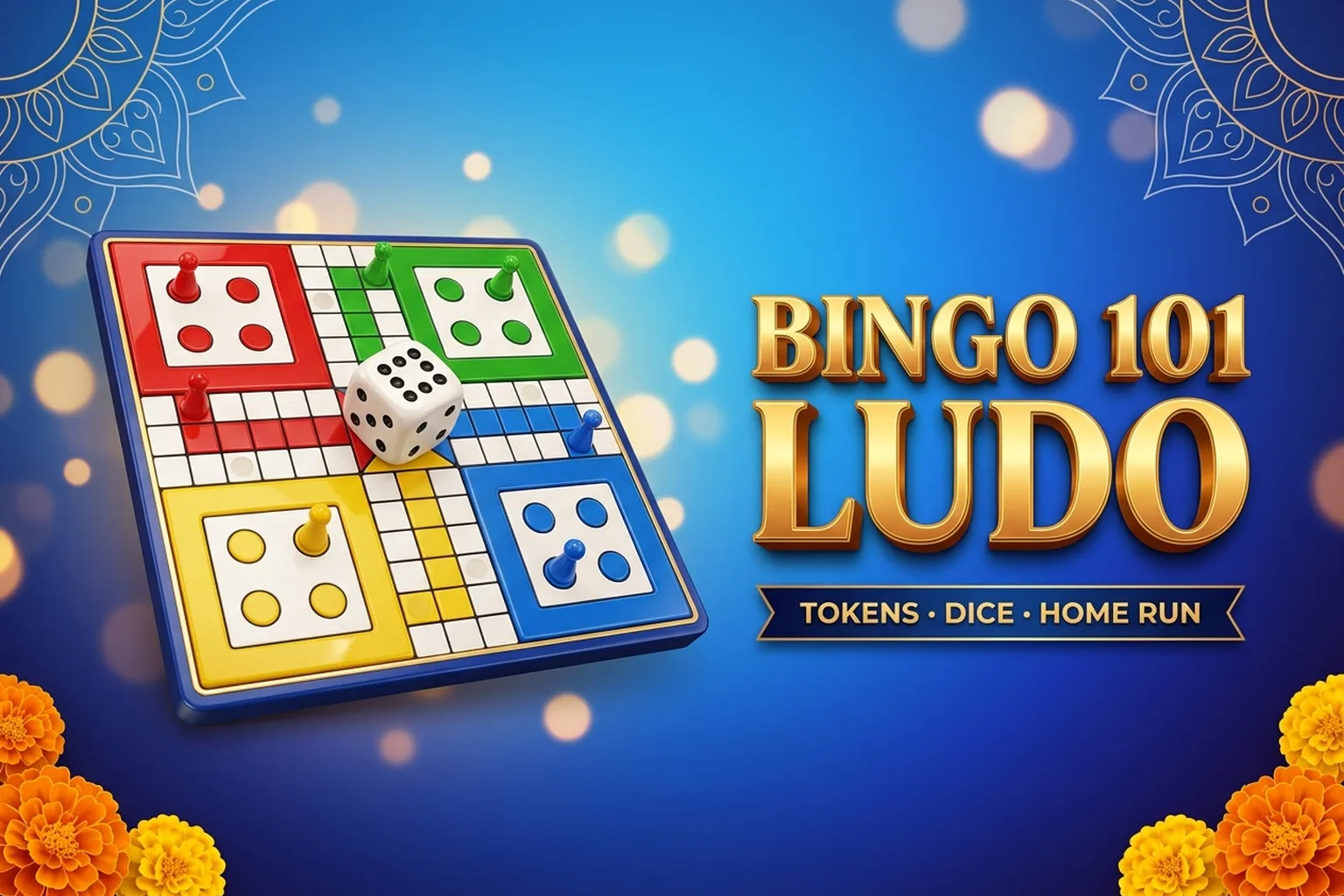
The board is a cross shaped track with four coloured corners. Each corner is a yard, and each player owns one colour and four tokens that start inside it. The shared track runs around the outside of the cross, 52 squares in the classic layout. From each colour's side, a coloured lane called the home column runs into the centre, and only that colour can use it.
The objective in classic rules is simple: bring all four of your tokens around the board and into the centre before the other players.
Turns and Movement
- Players take turns clockwise, rolling one die each turn.
- In traditional rules, a token can only leave the yard on a six. It moves onto that colour's starting square.
- A six usually earns another roll. Many rule sets cancel the turn if a player rolls three sixes in a row.
- Each roll moves one token forward by the number shown. If no token can move, the turn passes.
- With several tokens on the track, you choose which one to move. That choice is the heart of the game.
Captures and safe squares
If your token lands exactly on a square held by an opponent's token, that token is captured and sent back to its yard, where it has to wait for another six. In many versions a capture also gives you a bonus roll. Some squares are safe, usually the starting squares and those marked with a star, and a token on a safe square cannot be captured. In some rule sets, two tokens of the same colour on one square form a block that others cannot pass or land on.
How a game is decided
Two things work together: the dice and your moves. The dice are random and results settle on the server, so no phone, app or player can steer a roll. What you do with the roll is your part.
- Spread or stack. Moving one token far ahead is fast but leaves the others stuck. Spreading gives more options on each roll.
- Safety near danger. A token one to six squares in front of an opponent is within reach of a capture. Moving it to a safe square is often worth more than advancing another token.
- Capture when it costs little. Sending a token back costs the opponent a whole lap, but weigh it if the move leaves your own token exposed.
None of this is a winning system. In one game, luck has a large say. Over many games, consistent decisions tend to matter more.
Finishing a Game
After a token travels the full track, it turns into its own home column and heads for the centre. Once a token is in its home column it cannot be captured, so getting it there removes a risk from the board.
In classic rules a token needs an exact roll to reach the final square. A roll that is too high cannot be used for that token. The first player to bring all four tokens home wins, and in a game with more players the others can keep playing for the remaining places.
Online Ludo often shortens this. Common changes include a timer on each move, a fixed number of turns, points for distance travelled and captures, or a win for the first token home instead of all four. Whether a Bingo 101 Ludo table uses any of these is shown on the table or lobby screen. A timed game and a classic game call for different decisions, so check before you join.
A game of Ludo lasts longer than a card deal, so play on a stable network and keep the phone charged. If you are signed out or your session drops, the Bingo 101 login and account access guide explains how to get back in.
Variant-Specific Rules
LUDO and UONO Ludo can run different modes, fees and rules. Real money Ludo on gaming apps is usually built around an entry fee: each player pays to join, and the winner or top places receive a prize from the pooled entries, with the platform normally keeping a share. That is the general market model, not a description of a specific Bingo 101 table. No figure is given here because fees and prizes can change between tables.
Before you pay to sit at a table, read these on the screen:
- The mode. Classic, timed or a quick format with fewer tokens or a turn limit.
- The entry fee and prize. Add up what every player pays and compare it with the prize to see the price of the seat.
- The player count. Two player and four player games feel very different, and your chance of first place changes with the number of opponents.
- The move timer. A missed move may be skipped or counted against you, so a slow phone or weak signal becomes a real cost.
- The rules or information button. The place to check the six to start rule, bonus rolls, safe squares and what happens if you disconnect.
Finding Ludo and setting limits
Open the lobby and tap the Ludo category, then choose LUDO or UONO Ludo. There is no separate Ludo download: the game comes inside the single app, which you can install from the Bingo 101 APK download for Android page (version 1.2.0, 35.7 MB, Android 5.0 or later). Money for a game comes from the main balance, and the add cash guide explains top ups from a minimum of ₹30.
Rematches are fast, so decide before the first table: the amount you can afford to lose, the number of games, one entry level for the session and no top ups midway. The first add cash bonus is 10% up to ₹10,000, and bonus money carries conditions, so read the bonus guide first.
Myths worth deleting
- A predictor app can tell you the next roll. Rolls are generated on the server, and apps that claim otherwise are after your money or your login.
- A six is due after a long wait. Each roll is independent.
- Ludo is pure skill, so a good player always wins. Decisions help over many games, but one game can turn on two or three rolls.
For the other game where your choices matter most, read the Bingo 101 Rummy guide. Bingo 101 is for players aged 18 and over, and the responsible gaming page lists account controls.
Frequently Asked Questions
How do you move a token in Bingo 101 Ludo?
Each roll moves one token forward by the number shown, and in classic rules a token leaves the yard only on a six. Check the table's rules screen for how tokens enter the board and reach home.
Are safe squares and capture rules the same in every Ludo app?
No. Digital versions may use different safe squares, capture rules, timers or turn limits, so read the rules of the table you open.
Can you control the next Ludo dice roll?
No. Rolls are generated and settled on the server, and no app or method can choose or predict the result.
Where do I find Ludo in the Bingo 101 app?
Open the lobby and tap the Ludo category, added in late September 2026. LUDO and UONO Ludo are listed there.
Is there a separate Ludo app to download?
No. Ludo is a section inside the single Bingo 101 Android app and uses the same wallet as every other game.
Related Guides
- Bingo 101 Games: How Each Category WorksHow Each Game Category Works
- Bingo 101 Rummy: Rules and Game VariantsRummy Rules and Variants
- Bingo 101 All Games: Browse the CatalogueAll 216 Games by Category
- Bingo 101 APK Download for AndroidBingo 101 APK download
- Bingo 101 Add Cash and Deposit HelpAdd cash and deposit help